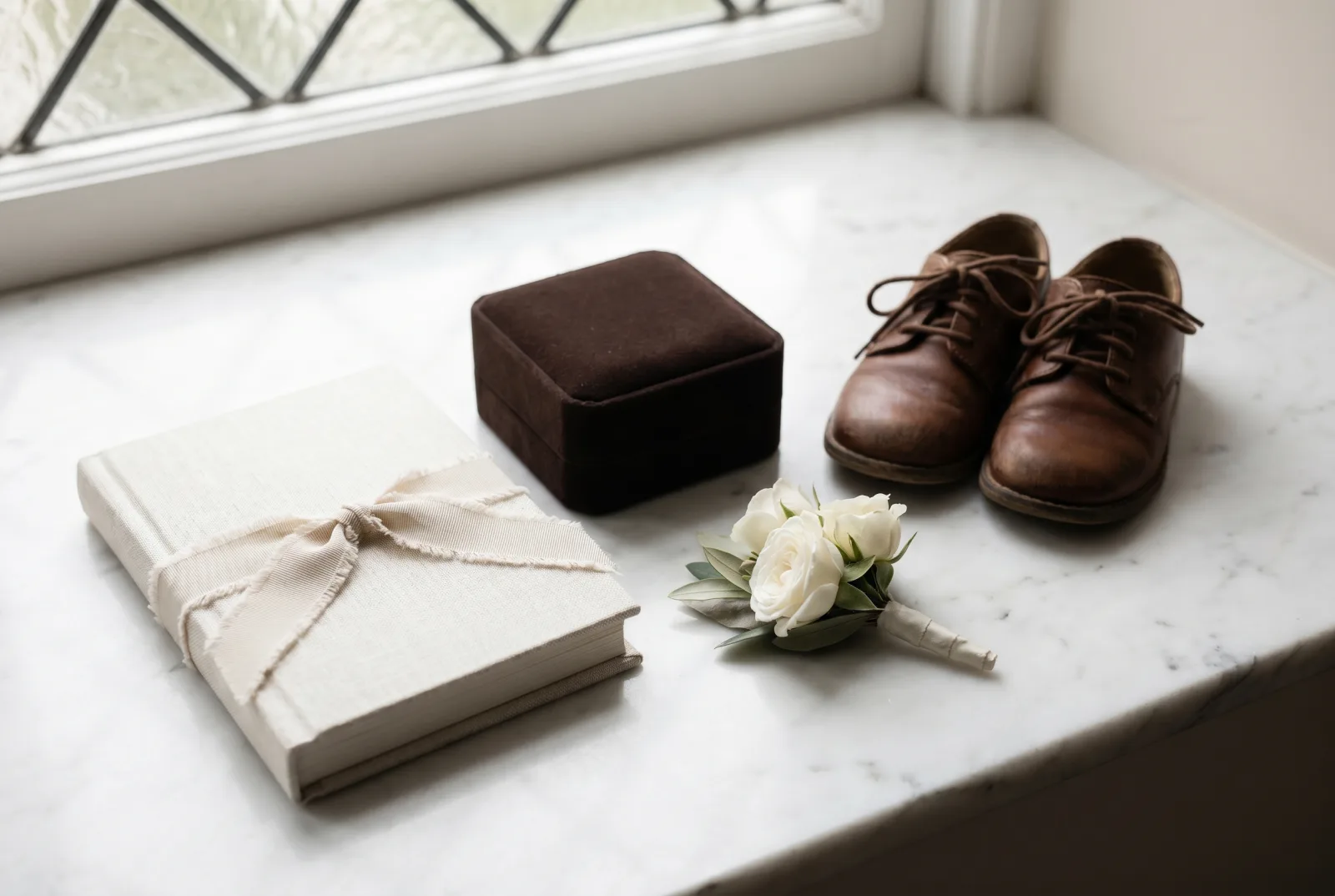
The ring bearer is small. He is four, or five, or seven — old enough to walk down the aisle holding the cushion with the rings on it, young enough that the household will be reminding him not to drop it for the entire week leading up to the day. The wedding party's gift register, calibrated to the adult attendants — the watches, the tie clips, the engraved silver cufflinks — does not scale down to him. He cannot wear a watch. The cufflinks would, in any case, be redundant; his shirt is fastened with buttons. The present has to be calibrated to who he actually is, not who the rest of the wedding party are.
What follows is the press's working account of what the ring-bearer present is when it is done correctly, what most weddings get wrong, and the form the press recommends for the small object that lasts. The recommendation is narrow and the form is specific. The ring bearer is, in most weddings, the smallest member of the wedding party; the present should be calibrated accordingly, and the calibration runs from the size of the object to the wording inside it.
Why the standard adult-attendant present scales down badly
The standard groomsman present is a small adult object — a watch, a flask, a leather wallet, a pair of cufflinks, a tie clip, a pen. The household receiving the present for the ring bearer often defaults to a scaled-down version of one of these objects. The child-sized watch. The smaller pocket knife. The miniature wallet with a printed bill inside it. The objects are pleasant in the moment of opening. They are also, in the survey data on wedding-party gift retention, almost always gone by the third year.
The reason is structural. The scaled-down adult object is, by definition, an object the ring bearer cannot yet use. He cannot read a watch. He has nothing to put in a wallet. He has no occasion for cufflinks. The object goes onto a shelf or into a drawer and sits there until the household quietly moves it on. The present that holds is calibrated to what the ring bearer can use — and what he can use, at four or five or seven, is an object he encounters by reading or being read to. The form is the small hardcover book.
What the small book does that the small watch does not
The book is calibrated to the ring bearer at every age he will be across the next two decades. At four, the parents read it aloud and he recognises his name on the cover. At seven, he reads it on his own. At twelve, he understands what the role was and pulls the book down to look at the illustrations of himself in the suit. At twenty, he keeps the book on a shelf in the apartment he has rented, as one of the few objects from his childhood he has taken with him. The form scales with him. The watch does not. The journal piece on the science of a book about themselves walks the cognitive side of why the self-referential form holds for child readers.
On the brief, calibrated to the ring bearer
The brief is provided by the bride and groom, often with help from the ring bearer's parents. It is short — three or four specifics about the ring bearer at the moment of the wedding. His age. The small suit he is wearing on the day. The phrase the household has been using to prepare him for the role. The object that has been giving him comfort during the weeks of preparation — the stuffed animal, the small blanket, the toy he carries to the rehearsal. The studio writes the book from those specifics.
The book opens with the ring bearer at home, in his own room, the morning of the wedding. The book proceeds, scene by scene, through the day — the drive to the venue, the moment the family helps him into the suit, the walk down the aisle with the cushion and the rings, the moment after the ceremony when the household is taking photographs and he is told he can have a biscuit. The book closes with the ring bearer falling asleep on the way home in the car. The form is the small narrative of the day, from his own perspective, written so he can read it on his own when he is old enough to. The journal piece on the personalized wedding gift walks the broader form for the adult guests.
On the small format
The format is engineered for a small hand. The book is six by eight inches — smaller than the press's standard hardcover format, which is eight by ten. The smaller dimensions let the four-year-old or seven-year-old hold the book unaided and turn the pages himself. The smaller format also fits in a single shoebox of childhood keepsakes in a way the standard format does not. Many parents keep the book, with a small set of other ring-bearer-day objects, in a single box on a high shelf. The box is opened on the child's eighteenth birthday, or at his own wedding, or on the morning of a quiet conversation about the day he was four and walked down the aisle with a cushion.
What the illustrations show
The illustrations render the ring bearer in the suit he actually wore. The colour of the lining of the jacket, the small bow tie, the polished oxford shoes. The press works from photographs the household provides — not as a photographic reproduction, but as a reference for the illustrator's hand. The result is a portrait of the ring bearer on the day, in the register of the older children's-book tradition. The journal piece on the science of a book about themselves walks the cognitive side of why this kind of specific self-recognition is the lever; the ring-bearer form is calibrated for a recipient at exactly the age the literature identifies as most responsive to the form.
On the parallel flower-girl present
Most weddings hand a parallel present to the flower girl. The form is the same — a small hardcover book, bound in the same materials, matte-printed with the same wedding date — but the brief is calibrated to her specifically. Her dress, her hair as it was done on the day, the basket of petals, the phrase she has been using to prepare for the role. The two books, ring bearer and flower girl, sit on each child's shelf at home. They are matched in form but specific in content. Across the decades that follow, the two books hold the wedding day from the two perspectives most easily forgotten by the adult attendees.
The press has, across years of wedding commissions, found the parallel pair to be the form most worth commissioning. Most other wedding-party presents are calibrated to the adult attendants and tend, in survey data, to be the presents the wedding-party members remember least. The pair of personalized books — given at the rehearsal dinner, read at home in the weeks following — sit in the long-keeping category. The form is calibrated for exactly the timescale the wedding party itself rarely is. The journal piece on engagement party gift ideas walks the form for the wedding-cluster engagement events.
On the small object, in church
The book is small. The form is calibrated to fit in a parent's pocket or a small leather case at the rehearsal dinner, not in a larger gift bag. The page count sits between sixteen and twenty-four, the smallest format the press uses. The cover bears the ring bearer's name and the wedding date. Nothing more.
The handover is brief. The bride and groom present the small package at the rehearsal dinner; the ring bearer opens it in front of the families. He looks at the cover, recognises his name, and looks at his parents. The parents tell him the book is about him on the wedding day. The book travels home with the family. It is read aloud in the days following the wedding, when the household has come down from the experience of the day itself.
- A small bespoke hardcover storybook with the ring bearer as the protagonist.
- A parallel bespoke book for the flower girl, bound to match.
- A small wooden Maileg figure or a working-craftsman keepsake calibrated to the child's actual play habits.
- A first-edition copy of a children's classic — The Velveteen Rabbit, Where the Wild Things Are, or Owl Moon — sourced from a reputable rare-books dealer and inscribed.
- A small handwritten letter from the bride and groom, sealed and stored with the book, to be opened on the child's eighteenth birthday.
What to skip
Skip the scaled-down watch. Skip the small flask, which the household will not, in any case, find appropriate. Skip the embroidered baseball cap with the wedding date. Skip the framed photograph of the wedding party from the ceremony; the photograph will be available later in much higher quality, and the framed object is calibrated to the adult sense of memorabilia, not the child's. Skip the gift card to a toy retailer; the gesture reads as the household's failure to choose.
Skip the trinket from the wedding-favours catalogue; the engraved miniature whisky barrel is calibrated to a generic wedding party, not to this specific ring bearer. The form to give is the form built for him specifically — small, written, illustrated, calibrated to the actual day he played a role in. The commission page is where the brief begins; the journal piece on the personalized big sister book walks the parallel form for a different family threshold.
What the form does, finally
Twenty years from the wedding day, the ring bearer is twenty-five, living in an apartment somewhere, on a shelf of which there is one small hardcover book bound in the wedding's accent colour with his name and the wedding date stamped on the cover. He has not opened it in two years. He pulls it down because his fiancée has asked him about the picture on the side table. He reads the book in twelve minutes. He understands, in a way he had not at four or seven or twelve, what the role actually was. The form has held. The wedding-party-gift list, calibrated to the adult attendants, had no object engineered to do this. The small bespoke book did.