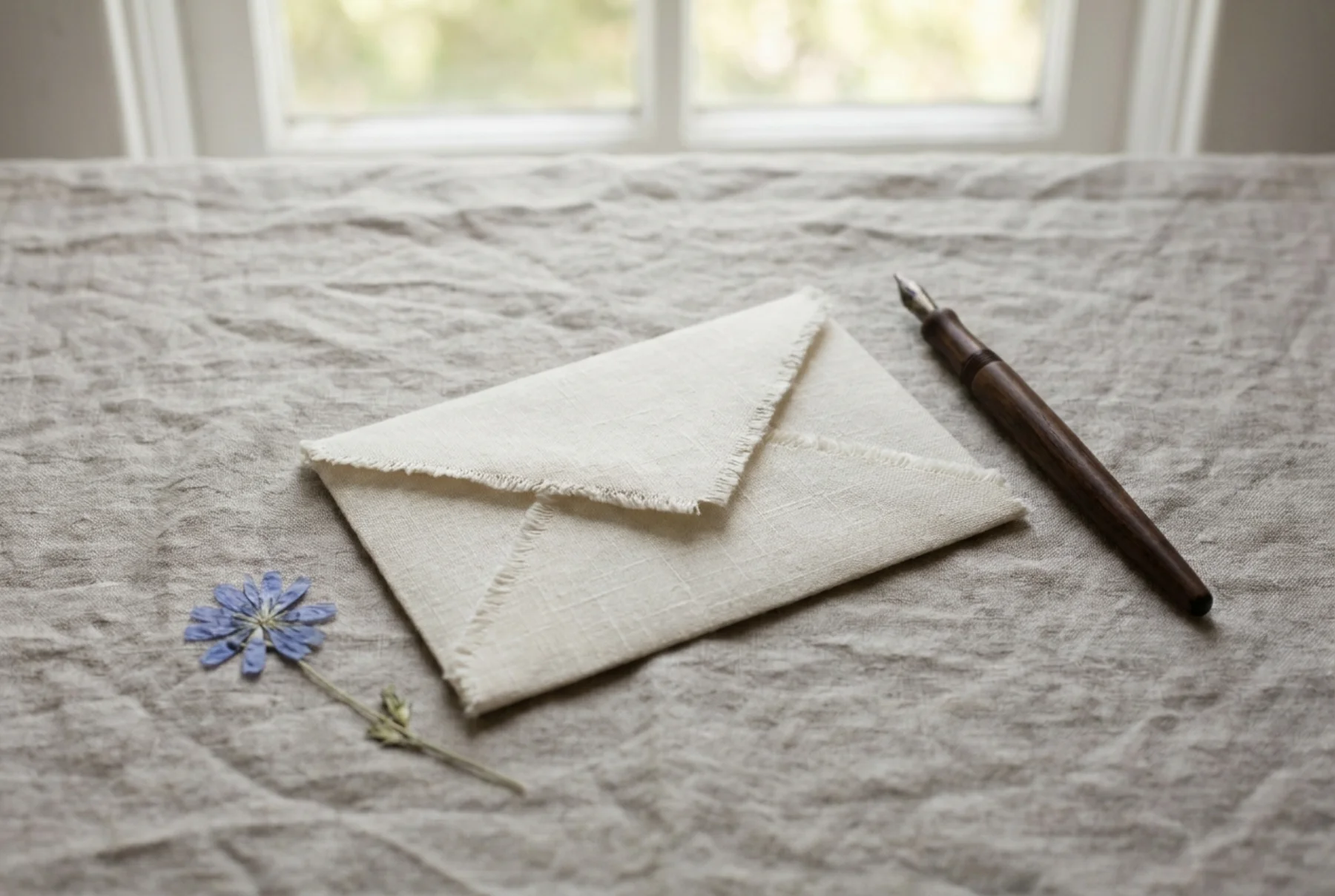
Most people have a letter to mom that they have never sent. It is not a draft. It is not a document. It is a long, ongoing composition that lives somewhere between memory and intention — the things you have noticed about her, the things you have wanted to say, the observations that accumulated over decades of watching her be who she is.
A letter to mom is the form we reach for when the occasion is important enough to require something more than a card. And it is, often, the form that breaks down partway through, because a letter is sixty words or six hundred words, and neither number is enough. This piece is about what that letter is actually trying to do, why the page keeps falling short, and the form that finishes the sentence the letter began.
What a letter to mom keeps trying to say
A letter to mom is, in most cases, trying to say: I see you. Not your role, not the service, not the motherhood in the abstract, but the specific person inside the role. The woman who answers the phone a particular way. Who has kept a particular object for thirty years without being asked to explain it. Who makes a particular dish in a particular season that the family would not name as her speciality but would notice immediately if it were gone.
That is what a letter to mom tries to say. It is a large thing and most letters are not large enough to say it. The page asks for a paragraph; the truth asks for a chapter. People sit at the kitchen table at midnight, scratching out the third opening, because what they want to put down is not one sentence but the steady accumulation of three decades of looking.
The lines you don't write down
There is a particular kind of sentence that comes up while you are writing to your mother and then gets crossed out, because on the page it looks too small. You always poured the tea before you sat down. You used to hum the same four notes when you were thinking. You wore the same earrings to every wedding for twenty years. These are the lines you delete. They are also the lines that, in the form that can hold them, do the most work.
The letter to mom that gets sent is usually the one with those lines taken out. The letter to mom that would move her is the one with those lines left in. The difficulty is that a page-and-a-half cannot hold ten of them without feeling crowded. A book can.
The form a letter cannot quite hold
A letter is a document. It lives in an envelope or a drawer or, increasingly, in an email thread. It is read once and then it is in a state of being-kept, which is different from being-returned-to. A letter on paper is precious; it is also fragile. It does not have a spine. It cannot stand on a shelf. It cannot be picked up by a grandchild ten years later and read aloud to the family during a quiet afternoon.
The form that can hold a letter to mom fully — including the parts that a letter cannot quite say — is a book. Not a letter bound in a book, but a custom storybook for mom written from the material the letter is trying to use: the specific observations, the particular details, the interior knowledge that only the people who love her have accumulated over the years.
A book is a different kind of object than a letter. It has weight in the hand. It has a cover, a spine, an end. It is built to be returned to. A letter says I wrote this once. A book says I made this for you, and it stays in the room. The shift between the two is the shift between a message and a keepsake edition of one.
“A letter says what you mean. A book holds what you have been noticing for thirty years.”
The book as a long letter
The storybook the press makes is, in its structure, a long letter to mom: a sustained piece of attention paid to one person, written with the reader in mind, trying to say something specific about a specific life. It uses the tools a letter uses — direct address, personal detail, the particular observation — but in the form of a narrative, illustrated, bound in a hardcover, matte-printed on the cover.
The book can hold thirty-two pages of specifics. A letter can hold, at most, a page before it begins to feel like too much. The book is calibrated for more, and the difference matters: the things you have noticed about your mother do not fit in a single page, and forcing them to is the reason most letters to mothers go unfinished in a notebook somewhere.
What a long letter holds that a short one cannot
The short letter holds one observation, well. The long letter — meaning the book — holds the pattern of observations across years. The fact that she has worn the same perfume since the year you were born. The fact that her handwriting changes depending on the time of day. The fact that she always reads the last chapter first, and then goes back. These are not climactic details. They are the texture. They are also the parts of her you would miss most if you woke up tomorrow and she were not in the world.
A book holds texture the way a letter cannot. It has the space to lay one specific next to another until the cumulative weight of them produces a portrait nobody could mistake for anyone else's mother. That is what people are reaching for when they write the letter. That is what the book delivers when the letter cannot.
On what to put in it
The brief for a book like this is the letter you have been composing. It asks: what does the family say about her when she is not in the room? What has she said, without thinking, that the family has memorised? What is her Sunday? Four specifics, one tone, and the studio has what it needs.
The brief itself takes ten minutes to write. It is, for most people who have been composing this letter for years, the easiest ten minutes of the process. The hard part was the decades of paying attention. The brief is just the place where that attention goes — the funnel that takes a long, ambient noticing and turns it into a manuscript a studio storyteller can write from.
The book takes a few weeks to make, and is pressed once. After it ships, the file closes. There is no second copy, which is appropriate: the letter to mom was always going to be for one person, and the form that holds it should follow the same rule.
- The phrase she says without thinking, that the family has memorised.
- The habit she has had since before you can remember.
- The thing she does on Sundays, specifically on Sundays.
- The observation about her that no one has ever said out loud to her face.
- The dish, the song, the smell — one sensory detail that means her instantly.
What the studio does with the brief
The brief goes to a storyteller in residence, who reads it the way a careful editor reads a letter — looking for the specific over the general, the strange detail over the predictable one, the line you almost cut over the line you led with. The manuscript that comes back is built from the brief but does not paraphrase it. It uses your detail as the spine and adds the rhythm a letter does not have time to develop.
The book is then illustrated, set in a serif text face, and matte-printed on a hardcover. A few weeks from brief to door. A description of the press itself and how a book is made is on the journal.
Prompts for the letter, when the page is blank
When you finally sit down to write the letter, the page tends to go blank — not because there is nothing to say but because there is too much. The most-wanted lines are the ones that feel too small to put down: the specific phrase, the Sunday detail, the gesture you have watched her make for thirty years without ever naming. These prompts are the ones that consistently produce specific writing — the kind a daughter or son could not have written about anyone else. They are also, almost without exception, the lines a personalized storybook for mom gets built from.
- The first thing she taught you that you still use, named precisely.
- The phrase of hers you have caught yourself saying, this year, out loud.
- The Sunday you remember best, and what was on the stove.
- The argument the two of you have had a hundred times, and what it is actually about.
- The thing she does that has never made sense to you and you have never asked her about.
- What you have not yet thanked her for, in those words.
- What you would want her to know about your own life that you have not said.
- The version of her you remember from before you were old enough to see her as a person.
You do not need to use all eight. Two used well — the right specific phrase next to the right Sunday, the right unasked question next to the right unthanked-for kindness — make a letter she will keep. Three used well make a long one. Eight used well, when the noticing has been accumulating quietly for decades, tend to outgrow the page and become the brief for the book.
On giving it with the letter
The book does not replace the letter. The book is the long version; the letter is the close-range one. Many people send both. The letter says I wrote you this. The book says and this is what I have been wanting to write for years. The two together are larger than either alone.
If the occasion is a birthday, the 60th birthday gift and 50th birthday gift categories on the journal both describe how a book like this lands at the milestone. If the occasion is grief, the memorial book is a related form. A letter to mom does not need an occasion. The book does not either. Most are made on a random Tuesday in May.
On the difference a book makes in the room
A letter to mom, once read, gets folded back into the envelope and put somewhere safe. It is not displayed. It belongs to her privately, and that privacy is part of its value. A book is a different presence. It sits on the shelf where the family can see it, spine outward, and over the years it becomes furniture in the same way a wedding photograph becomes furniture — noticed in passing, opened occasionally, present in the background of the room.
The book becomes the thing the grandchildren reach for and read aloud at the dinner table during the long holiday afternoon when no one knows quite what to do. It becomes the thing that gets passed across the table at the fifty-fifth birthday and the eightieth one. The letter cannot do that work; it was not built for it. The single-edition keepsake is built for exactly that.
“What you wanted to say to her in one page is what the book says in thirty-two, with room for the silences a letter does not have time for.”
Common questions
Q: Is a letter to mom better than a storybook?
A: A letter is immediate and direct. A personalized storybook for mom holds more and lasts longer. They are not competing forms; many people write both. The book is the long version.
Q: What do I write in a letter to mom that will actually move her?
A: The specific thing. Not 'you are the best mother' but 'the way you answered the phone every time I called, on the second ring, never the first.' The specific thing is what she does not know you noticed. That is the thing that moves her.
Q: Can the studio write the letter for me?
A: The studio writes the storybook from your brief. The brief is the letter you give to the studio. If you can describe your mother in four specific details, the studio can write everything else.
Q: How long should a letter to mom be?
A: Long enough to be specific and short enough to be read in one sitting. A page is usually right. Anything longer tends to want to be a book instead — which is fine, and is the point of the form the press makes.
Q: Can I include the letter inside the book?
A: Not inside the binding, but alongside it. Many buyers send both. The letter is dated; the book is not. Together they hold the moment and the long arc.