My mother could not read the eulogy at her sister's funeral. She had written it the night before on the back of a printed boarding pass, and at the lectern she got two sentences in and handed it to me. I read it. It was four hundred and twelve words. It was the best thing she ever wrote, and she has been a writer her whole life. Most eulogies are written in a single night, and most of them are short. This is a piece about how to write one of them on purpose.
There is no template for this — or rather, the templates that exist are mostly useless, because the eulogy is not a form essay, it is a small piece of literature read aloud in front of a grieving room. What follows is a working method, not a fill-in-the-blank. I will be honest about what works and what does not, and I will tell you what to do when the throat closes at the lectern, because it almost certainly will.
What a eulogy actually is
A eulogy is a short spoken portrait of one person, delivered at their funeral or memorial, by someone who knew them. It is not a biography. It is not an obituary read aloud — that is a different document, and we wrote about how to write an obituary separately because the SERPs collapse them and they should not be collapsed. A eulogy is a literary form with one constraint the obituary does not have: it is read aloud. Every sentence must survive being said in a wavering voice.
The other thing a eulogy is: an act of public memory. The room is collectively constructing the person they will remember, and the eulogy is one of the building blocks. What you put in stays. What you leave out is, in a quiet way, gone. That is a heavy thing to hold for an hour at a kitchen table the night before, and it is one reason eulogies are hard to write. They are not just words; they are a small piece of the future.
The seven-step method for writing one
Most eulogies are written under pressure, on a single evening, by someone who has not slept. The method below assumes that. It is built to be done in about two hours, in order, on paper or in a single document, with the phone face-down.
- Pick one angle, not a life.* Choose a single thread — "my father, the gardener," "my friend, who answered every text within four minutes," "my grandmother, who never apologised for the lipstick on the cup." The whole eulogy hangs on this one thread. A eulogy that tries to summarise an entire life summarises none of it.
- Write down five specific scenes.* Real moments, on paper, in one sentence each. The Tuesday she made the lasagna. The phone call from the airport. The drive back from the hospital with the radio low. Specifics are the entire game.
- Pick three of the five.* Cut the two that do not fit the angle, even if they hurt to cut. You can mention them at the wake. A eulogy is short because the room is tired.
- Write a first sentence the room can see.* Not "my father was a wonderful man" — that is generic, and no one will remember it. Try "my father kept a small notebook in the drawer by the phone where he wrote down the name of every plant he ever killed." That, the room will remember.
- Write the close before the middle.* Decide the last sentence first. A landing is a kindness; a eulogy that trails off makes the room anxious. The last sentence is often the line the person actually said, or a single observation that sums the angle without explaining itself.
- Fill the middle.* Three scenes, each one a paragraph, in roughly chronological order. Each scene should have one piece of dialogue or one concrete object. Anything abstract gets cut. "Generous" is not in a eulogy; "she sent a casserole to every family on the block after my brother was born" is.
- Read it aloud, twice, with a stopwatch.* Aim for six minutes. Cut anything that does not survive your own voice. If your throat closes at a particular line, mark it with a dot in the margin so you know it is coming, and so does the person who is sitting in the front row ready to take the page from you.
What the angle does
The angle is the thing that turns a list of nice memories into a piece of writing. It is the answer to the question, why this person, in this way? Without an angle, a eulogy becomes a string of compliments; with one, it becomes a portrait. The angle does not need to be profound. "My grandfather, who fixed every broken thing in our house with the same roll of grey duct tape" is enough. The angle gives the room something to hold onto.
What to do at the lectern
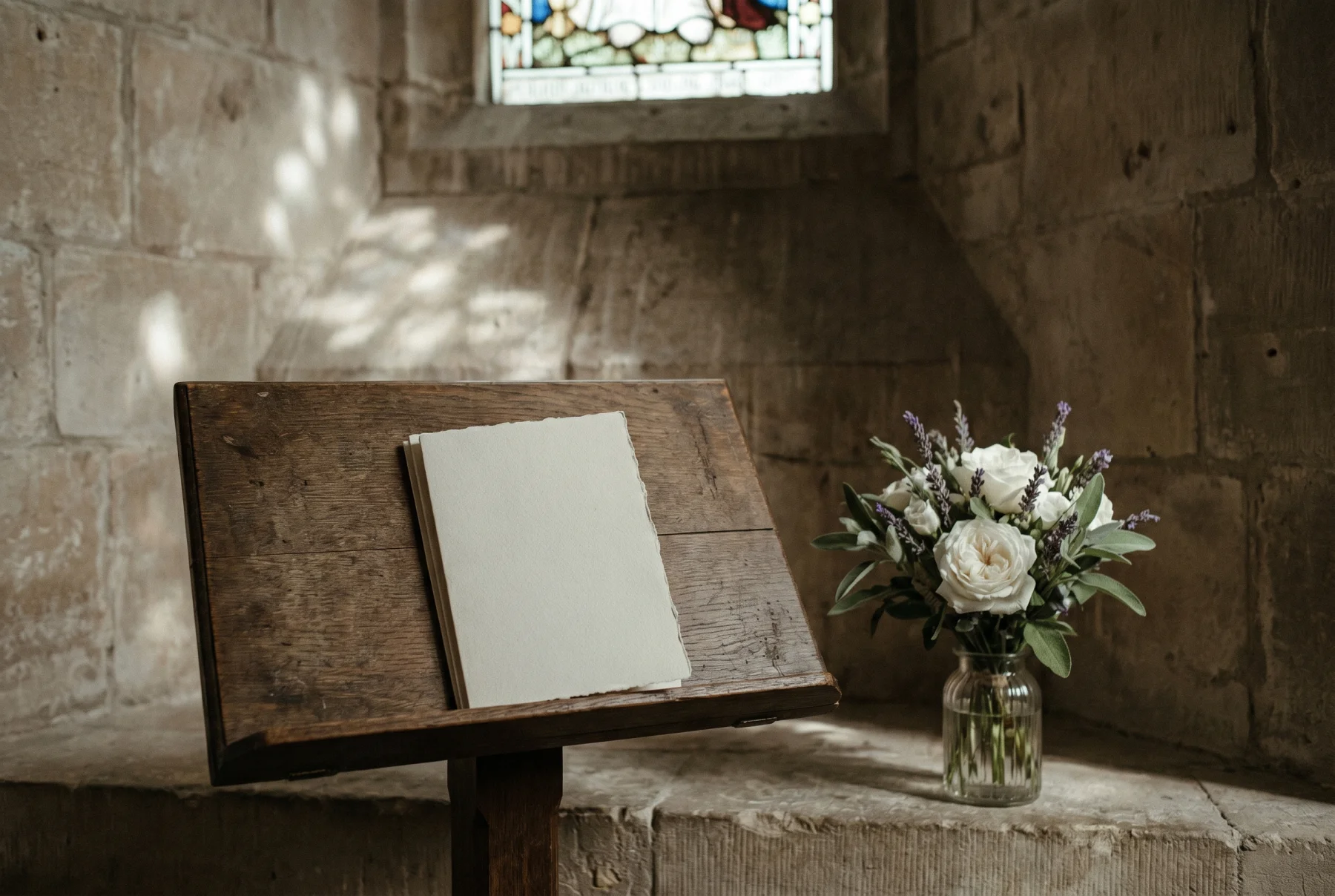
Print the eulogy in 14-point type, double-spaced, on one side of the page only. Number the pages. Bring two copies — one for you, one for the person who will read it if you cannot. Keep a glass of water within reach. Speak slowly; the natural impulse under stress is to speed up, and the room cannot follow a fast eulogy. Pause after each scene. Pauses are not awkward; they are the room catching up.
If your throat closes, stop. Put the page down on the lectern, take three breaths, and pick up where you stopped. The room will wait. No one in that room is checking the time. If you cannot continue, the person you nominated comes up and reads from where you stopped. There is no failure mode at a funeral. There is only the room, and the room is on your side.
Things that work, and things that do not
What works: specifics, one good joke if the person was funny, a single piece of dialogue, a recurring object, a final sentence that does not explain itself. What does not: vague abstractions, lists of accomplishments without scenes attached, sentences that begin with "he was always there for us," and any phrase that could apply to anyone. The test is simple — if the sentence could be read at a different funeral and still fit, cut it.
The line you will be tempted to write, and should not
"Words cannot express." "There are not enough words." "Where do I begin." These are throat-clearings, not writing. They are the sentences you write when you are stalling. Cut them in the second draft. Begin with the first real scene. The room knows words are insufficient; you do not need to tell them.
After the eulogy is read
The eulogy you wrote in one night, on the back of a boarding pass, will outlast the funeral. People will ask for a copy. Send it to them. Keep the original — many families now bind the eulogy into the order of service or into a memorial book, printed properly, so the words are not lost on a folded piece of paper in a drawer. The eulogy is a piece of writing about one specific person; that is exactly the thing a memorial book is built to hold.
If you are planning the service itself, the journal's note on celebration of life ideas gets into the wider question of how the day is shaped, and sympathy gifts that are not flowers gets into what to send the family afterwards. If you are writing a card to someone whose person has just died, what to write in a sympathy card is the companion piece to this one.
On reading a eulogy you did not write
Sometimes you are not the writer; you are the reader, holding pages someone else wrote because they cannot stand at the lectern. Read them slowly. Honour the choices the writer made — do not improvise. If a line lands hard, let it land. If you need to pause, pause. The writer chose every sentence. Your job is to deliver them faithfully, which is itself a kind of love.
It is also worth saying, quietly, that the eulogy is a complete literary form in itself — closer to a short-form memoir than to any other genre. It selects, it interprets, it arrives at a small meaning. The fact that most eulogies are written in one night, by someone who has just lost a person, and that they still manage to be that — is one of the more astonishing things people regularly do.
On grief, while writing
You are writing this in grief. The grief will sit on the page next to you, and it will try to take the pen. Let it. The first draft is for the grief; the second draft is for the room. Cry while you write the first draft. Cut while you write the second. The eulogy that comes out of that two-pass process is almost always better than the one written with a stiff upper lip from the start. The grief is not the enemy of the writing; the avoidance of grief is.
If the death is recent enough that you cannot get through a draft without breaking, work in twenty-minute blocks. Set a timer. Write until the timer goes, then close the document and walk away. Come back in two hours. The eulogy will be there. So will the grief. Both of them will still be there at the lectern, and that is fine. The room expects both.
On co-writing with siblings
If you are writing the eulogy with one or more siblings, divide by angle rather than by chronology. Each sibling takes one angle — "our mother, the gardener," "our mother, who called every Sunday at four" — and writes their three minutes around it. Do not try to merge the drafts into a single piece; the seams will show. Read them in order, as three short eulogies, each from a different child. The room will hear the mother three ways, which is closer to the truth than any single angle could be.
A short worked example
Here is the angle of one: my aunt, who never let anyone leave her house hungry. The three scenes: the Tuesday casseroles for the family on the block, the sandwich she made for the man who came to read the meter, the freezer she kept stocked for the grandchildren who turned up unannounced. The first sentence: "My aunt's freezer was a public utility." The last sentence: "There is, in her kitchen now, a casserole that she made before she went into the hospital. It is in foil. It is labelled. We are going to eat it tonight."
That is the whole eulogy, in outline. Three scenes, one angle, one specific opening line, one specific closing line. The middle writes itself if the bones are right. The bones are the only thing worth spending the night on.
— A eulogy is six minutes long, one person wide, and one angle deep. The angle is the entire piece. Everything else is decoration.