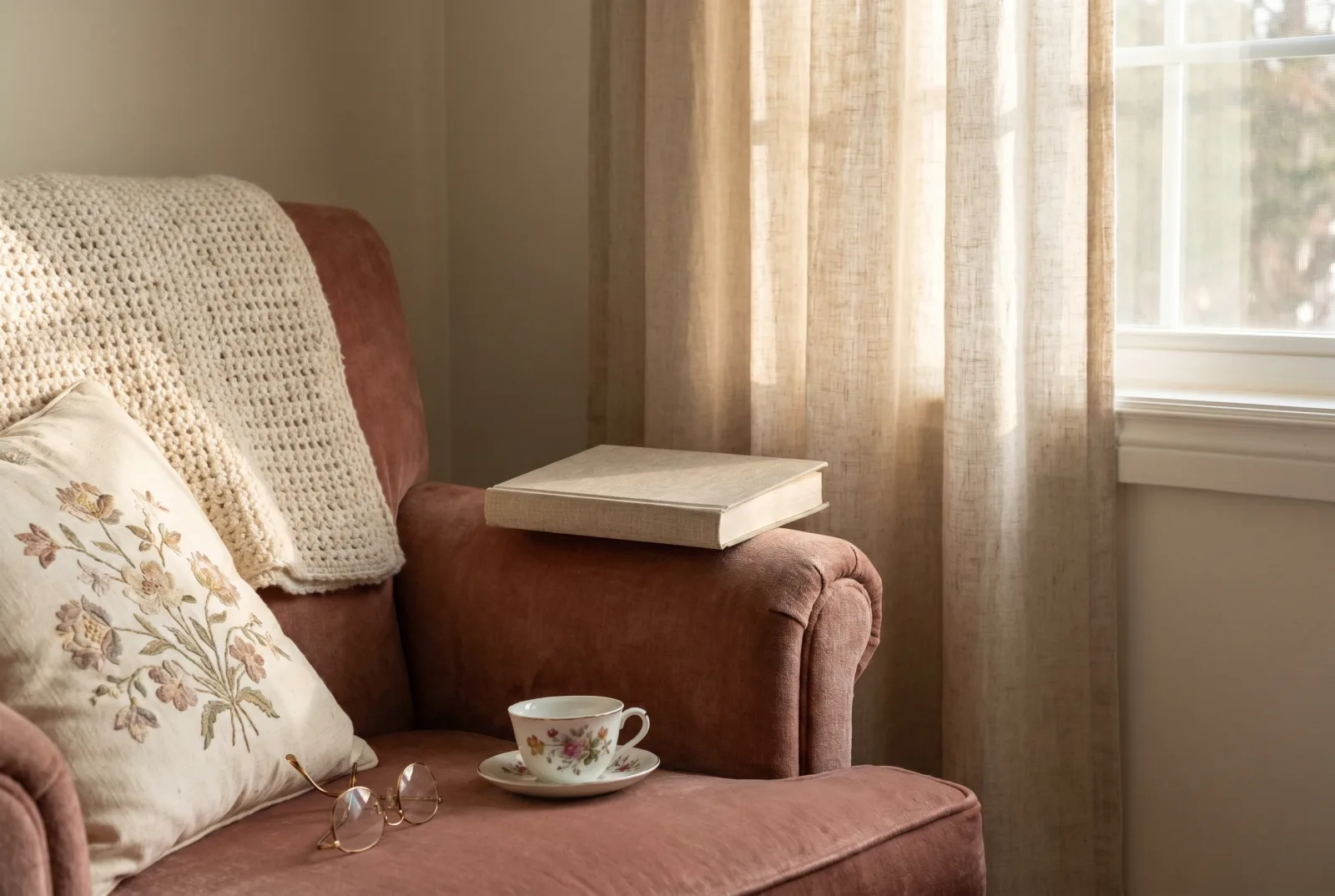
Most personalized presents for grandmothers are not the right form. The high-street catalogue is calibrated, in practice, to the same eight or nine objects across every season — the picture-frame with the family photograph, the engraved silver locket, the embroidered cushion with the grandchildren's names worked in, the recipe-book template with the family name on the cover. These objects are pleasant in the moment of receiving and forgettable in the year that follows. They sit on the side table for a few months. They migrate to the drawer. The grandmother is fond of them. She does not, in real terms, return to them.
The grandmother form, when it is done correctly, is a different object. It is written, not engraved. It is illustrated in the visual register she grew up reading in, not the contemporary register her grandchildren see in their own books. It is bound to sit on her shelf — at eye level, in the room she reads in — rather than on a side table. It is calibrated, in every choice from the cover material to the page count to the typeface, to the specific woman who is receiving it. What follows is the press's working account of what the form is and how it is bound.
Why most personalized grandmother presents fail
The standard personalized grandmother present fails on a structural level. The picture frame with the family photograph is generic; the same frame could hold a different family. The engraved silver locket is durable but not narrative; it carries an inscription but does not tell a story. The embroidered cushion is specific but not portable; it sits on a sofa, where it is encountered passively. The recipe-book template is closer to the right register but is, in most cases, calibrated to the grandmother's role as cook rather than as the person she actually is.
The bespoke book bound for her, by contrast, sits in a category most catalogues do not stock. It is written specifically for her. It is illustrated in a register the household has chosen because the household has noticed which painters she returned to as a younger reader. It is bound in materials calibrated to her bookshelf, not the giver's. The form does, structurally, what the standard objects do not — it makes a specific document about the relationship that her grandchild and the rest of the family have with her, and it does so in language and image she actually reads. The journal piece on the personalized book for grandparent covers the broader form in detail.
What makes the form different
Three structural decisions distinguish the grandmother book from the standard personalized object. The voice is the grandchild's, not the parents'. The visual register is mid-century, not contemporary. And the brief is short enough that the book breathes; the form is calibrated to be read in twenty minutes once, returned to in the same twenty-minute reading window across decades. The three together produce an object that holds where the standard catalogue items do not.
On the visual register, by generation
The grandmother reading the bespoke book is, in most households, between sixty and ninety years old. She grew up reading the picture-book canon of the 1940s, 1950s, and 1960s — Beatrix Potter, Tasha Tudor, Jessie Willcox Smith, Edward Ardizzone, Maurice Sendak's earlier work. The visual register of those books is painterly, soft-edged, and warmer in colour than the contemporary picture-book catalogue. The press's working observation, across hundreds of grandmother commissions, is that books illustrated in this older register land harder than books illustrated in the contemporary one.
The press works with illustrators trained in the painterly tradition for the grandmother form. The palette is cream, sage, soft rose, warm brown — the palette of the books she read as a girl. The pages are uncrowded; the typography is slightly larger than the standard adult book to accommodate the reading glasses she now keeps on the side table. None of these choices are accidental. Each is a small piece of the form, and together they produce a book that sits naturally on her shelf next to the older volumes she still keeps.
On the brief, written from the grandchild's perspective
The brief comes from the parents — the grandchild is, in most cases, too young to write the brief himself — but the voice of the book is the grandchild's. The parents provide three or four specifics about the relationship between the grandchild and the grandmother. The Sunday morning she comes over for breakfast and brings the particular biscuits from the bakery on her route. The story she tells about her own grandmother and the kitchen she grew up in. The phrase she uses when she walks into the room — there she is, or come and sit beside me. The studio writes the book in the grandchild's voice from those specifics.
The book opens with the grandchild's introduction of his grandmother. This is my grandmother. She comes over every Sunday morning. She brings the orange biscuits from the bakery on the corner. The book proceeds, scene by scene, through the small specifics of the relationship. The grandmother, reading the book, recognises every detail because every detail has been provided by the household. The reading is the moment the form does its work; the binding is what makes the reading possible across the years that follow. The journal piece on a custom book for mom walks the form for the partner-parent version of the same relationship.
Four specifics that hold the relationship
- A small ritual the grandmother brings into the household — the Sunday biscuits, the Friday phone call, the holiday tradition she has been keeping for decades.
- A story she tells, in her own words, that the grandchild has heard her tell.
- A phrase she uses, repeatedly, when she is with the grandchild — recorded as she actually says it.
- An object of hers the grandchild has been watching — the teapot, the cardigan, the reading glasses, the chair she sits in.
On the typography and the page
The typography matters more than most catalogues acknowledge. The grandmother's reading glasses are calibrated to a particular type size; under-sized type, however elegant, becomes a barrier to the reading. The press uses Garamond or Caslon at a point size slightly larger than the contemporary picture-book default — twelve or thirteen point rather than the more usual eleven. The line spacing is generous. The text sits on the page rather than crowding it. The grandmother reads the book without strain; the form is calibrated to her eyes, not to the catalogue's design conventions.
On the materials, calibrated to her shelf
The book is matte-printed on the cover with her name — for grandmother — and the year. The lettering is in the same restrained foil — matte gold, copper, or dark bronze — that the older volumes on her shelf use. The endpapers are pale, the typography is calibrated for ease of reading at sixty or seventy or eighty, and the page count sits between twenty-four and thirty-two. Longer than that and the form starts to feel like a book she has been assigned; shorter than that and the form does not have room to develop the specifics. The journal piece on the quiet luxury of a personalized book walks the material side at length.
On the handover, in her room
The book is given in her room, not at the table. The form is calibrated for a private reading, not a public one. She puts on her reading glasses. She reads the book once, slowly, taking about twenty minutes. The grandchild sits beside her if the household has arranged it; otherwise the parents sit across the room. She does not say much during the reading. She turns the pages slowly. She lingers on the illustrations.
When she finishes the book, she closes it. She does not say much for a few minutes. She puts the book on her side table, next to the lamp. It will sit there for two or three weeks. Then it will migrate to the shelf at eye level — the shelf with the books she has been keeping across her own lifetime. The book will sit there for the rest of her life. After her death the book will pass to one of her children or grandchildren and will sit on a different shelf for the next generation. The form is engineered for exactly this multi-generational migration; the binding holds across decades because the books on her shelf have already demonstrated, by their own age, that the binding will.
What to skip
Skip the picture-frame with the family photograph, however carefully composed. Skip the engraved silver locket; it will sit in the drawer with her other jewellery. Skip the embroidered cushion with the grandchildren's names worked in; it will sit on the sofa but will not be returned to. Skip the recipe-book template with the family name on the cover; she has not been a working cook for some years and the framing is, in most cases, slightly off. Skip the experience voucher for the spa day or the cooking class; she may not, depending on the year, have the bandwidth to use it.
Skip also the silver-plated objects from the standard giftware catalogue. The grandmother's shelf is calibrated to objects in older traditions — printed books, made for this one book ceramics, hand-knitted textiles — and the silver-plated giftware sits in a different visual register. The piece will be received politely and then quietly displaced. The form to give is the form that joins her shelf, not the form that competes with it. The journal piece on the personalized book for grandparent walks the form for the broader category; the commission page is where the brief begins.
What the form is, in the end
A bespoke book for a grandmother is a piece of writing about the specific relationship her household has with her, written in her grandchild's voice, illustrated in the visual register of her own girlhood reading, and bound to sit on her shelf for the rest of her life and the lives of the generations that follow. The form is not magic. It is a reasonable application of the press's working method to a specific recipient with specific shelf criteria. The book ships a few weeks later. The handover takes twenty minutes. The keeping takes generations. The journal piece on the science of a book about themselves walks the cognitive-recognition side for grandchildren reading the same form a generation on.