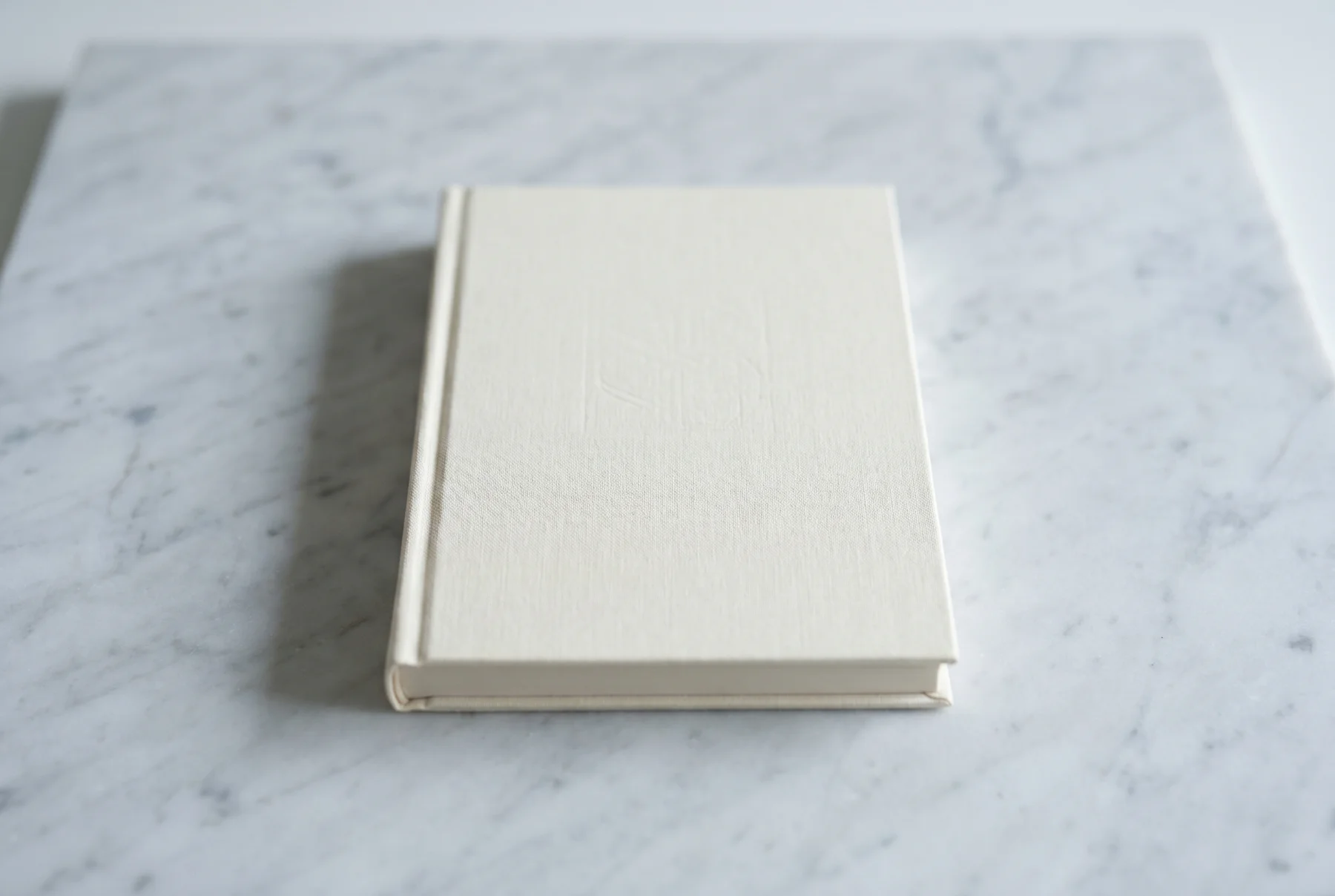
Quiet luxury is a phrase that has acquired enough usage in the last few years to be in danger of becoming its opposite. It now appears in trend reports, magazine spreads, and the marketing copy of brands that have never been quiet about anything. The phrase itself is older than the trend cycle — Stealth Wealth was the previous name for the same idea — and the underlying discipline is older still. This piece is about that older discipline. Specifically, it is about how a single-copy personalized hardcover book belongs in the same category as a Loro Piana cashmere coat, an Aesop bottle on a basin shelf, and an Hermès Birkin in undyed leather.
The argument is straightforward. Quiet luxury is not a look. It is an attitude towards what an object should announce, and the answer the attitude gives is nothing visible from across the room. A book pressed once for one reader, matte-printed with one word on the cover, is the literary version of the same answer. The full structural piece on the form sits in the journal's note on what makes a custom hardcover storybook; this piece is about the category the form sits inside.
Quiet luxury, defined
Quiet luxury is the discipline of owning expensive things that do not announce themselves. The list of objects the category includes is long, but the rules are short. The materials are unimpeachable. The design is minimal. The maker does not put a logo on the outside. The buyer does not need to be told what the object cost. The object is recognised only by people who already know the maker — which is, deliberately, a small and self-selecting group. The pleasure is interior, not performative.
The phrase has older roots than the recent cycle suggests. The mid-twentieth-century New England version was called old money. The 2010s tech-industry version was called normcore. The post-pandemic version is called quiet luxury and includes Phoebe Philo's revived Céline aesthetic, the entire output of The Row, the unlogo'd corners of Loro Piana, Toteme's Stockholm restraint, Lemaire's Parisian one-shoulder coats, Khaite knitwear, Cabana magazine's interiors, and the smaller corner of the secondhand Hermès market that values the original Kelly over the more recognisable Birkin.
What separates quiet from loud
Loud luxury is the visible announcement: the monogrammed canvas, the contrast red sole, the silver script across the chest. The buyer is signalling, sometimes with affection and sometimes with anxiety, that they have access to the named maker. The signalling is the point. The object is, in effect, an advertisement that the buyer is wearing for the maker.
Quiet luxury reverses the relationship. The buyer is not advertising. The maker is not announced. The object is recognised only by people who already know what they are looking at, and the recognition is the smallest possible signal: a glance, a nod, the briefest pause at the cuff of a coat. The buyer who wants the loud signal will find quiet luxury frustrating; the buyer who already has access and does not want to perform will find loud luxury embarrassing. The two are not in competition. They are operating in different rooms.
The seven hallmarks of a quietly luxurious object
The discipline is more specific than the phrase suggests, and most quietly luxurious objects share the same seven characteristics. The list below works as a checklist: an object missing more than two of these is probably not the thing the category names.
1. The materials are unimpeachable
Loro Piana cashmere starts as fibre from a specific breed of Mongolian goat, combed by hand, sorted by length. The Row uses Italian-spun yarns that cost three times what the high-street equivalent costs. Materials are the floor; everything else builds up from it.
2. The construction is hand-finished
Most Loro Piana knitwear is finished by hand. Most Hermès leatherwork is saddle-stitched by hand. The hardcover book is matte-printed and bound one at a time. The handwork is invisible to anyone who is not looking for it; it is the difference, however, between an object that lasts and one that gives up.
3. The palette is restrained
Cream, navy, camel, ochre, oxblood, undyed wool, fawn. The colour spectrum of quiet luxury is the spectrum of the early Northern Renaissance painters. The bright primaries belong to loud luxury, to fast fashion, and to the under-eight market. The restrained palette ages; the bright palette dates within a season.
4. The object is anti-logo
Loro Piana's logo, when it appears at all, is inside the garment. Aesop bottles carry no brand mark on the front. The hardcover book carries no studio mark on the cover; the press wordmark sits at the colophon, the small page at the back, in foil the same shade as the cover. The buyer's identity is not the maker's marketing surface.
5. The price is not visible
Quietly luxurious objects do not advertise their cost. There is no published retail price.* The book’s price is listed openly, which is the publishing-trade version of the same restraint: the price is what it is, and there is no negotiation around it.
6. The object lasts
The Hermès Birkin from 1984 is still in service in 2026. The Loro Piana cashmere coat from a decade ago looks better now than it did new. The hardcover book pressed in 2026 is built to be opened ten thousand times. Quiet luxury is, structurally, a bet on duration. Loud luxury is a bet on the current season. The two categories settle differently in the buyer's life: one becomes furniture, the other becomes archive.
7. The recognition is interior
The buyer's pleasure is private. The Loro Piana cashmere is recognised by the hand that touches the sleeve before the eye registers the silhouette. The hardcover book is recognised by the reader who opens it, not by the dinner guest who sees the spine. Quiet luxury is built for the interior of a life, not for the photograph of it.
Why a personalized book is the quietest possible luxury
The personalized hardcover is, by structural design, the quietest object the category includes. It carries no visible marker of its cost. It has a matte printed cover with one word — usually a name or a phrase — that means nothing to anyone outside the household. It cannot be re-bought, because the manuscript was written from a brief that only one household could supply. The object is functionally invisible to anyone who has not opened it, and is, to the person who has, the most specific object in the room.
The reasoning runs all the way through the studio's choices. The packaging is packed for shipping. The press wordmark is at the colophon, not the cover. None of these decisions is decorative; each is the literal application of the seven hallmarks above. The book is meant to live alongside the rest of the household's quiet objects — the Loro Piana throw on the sofa, the Mast Brothers bar of dark chocolate in the kitchen drawer, the Cire Trudon candle on the side table — without competing for the room's attention.
The objects quiet luxury is replacing
Quiet luxury, as a category, is replacing the previous decade's status objects. The monogrammed canvas tote is yielding to undyed linen. The logo'd sweatshirt is yielding to The Row's tonal knitwear. The branded perfume is yielding to Aesop and Le Labo's plain pharmacy bottles. The mass-produced photo album is yielding to the single-copy hardcover. The pattern is the same: the loud object retires to the back of the closet, and the quiet object takes its place at the front.
The shift is not new. Stealth wealth has been a current in American taste since The Preppy Handbook in 1980; it surfaced again in the post-2008 retrenchment, and once more after the pandemic. The personalized hardcover sits inside the same current. The journal's note on what sundayfawn is makes the studio's position explicit; the note on the sundayfawn press describes the operational discipline that produces the object.
What goes inside the cream cover
The interior of the book is the only place quiet luxury allows announcement, and even there the announcement is restrained. The text is a short literary portrait of one person, six to ten spreads, illustrated in. The voice is what Cabana magazine calls the warm room — close enough to feel intimate, far enough to feel composed. The reader who opens the book is the only audience the book has.
The brief that produces this is filled in at the create page and is structurally calibrated for the form. The questions are about interior detail — phrase, Sunday, object, route — rather than biographical summary. The journal's note on writing something meaningful in a personalized book covers the texture of the writing in detail. The journal piece on the personalized book for adults covers the audience the book is structurally calibrated for.
“The most expensive thing on the page is restraint. The most expensive thing in the room is the object that does not announce itself.”
Where a sundayfawn book sits in a quietly luxurious life
On the shelf with the spine outward. Not on the coffee table. Not in the office. The book is recognised by the household that owns it and by the small number of guests who already know what the cream-and-foil cover indicates. It is opened on the kind of afternoon that calls for opening one specific object — an anniversary, a quiet Sunday in February, the year after a death — and is otherwise present in the room the way a Saarinen side table is present: not announcing itself, not requiring attention, just there.
This is the room quiet luxury furnishes. A Lemaire coat in the hall. An Aesop bottle on the basin. A Cabana issue on the side table. A Cire Trudon candle in the dining room. A single hardcover book on the shelf at eye level, matte-printed with one word, written about the person who lives in the room. The book is the smallest object on the list. It is also, structurally, the only one of the objects that cannot be replaced. The journal's note on the edition-of-one form is the longer version of why the irreplaceability matters.
Quiet luxury is not about owning the right brands. It is about owning the right objects for the interior of a life — objects that will outlast the trend cycle that named them. The personalized hardcover belongs in that category for the same reason a Loro Piana cashmere coat does: not because it is loud, but because it is right. It is the quietest possible luxury: an object pressed once, for one reader, that lives on a shelf for forty years and announces nothing to anyone except the person who opens it.