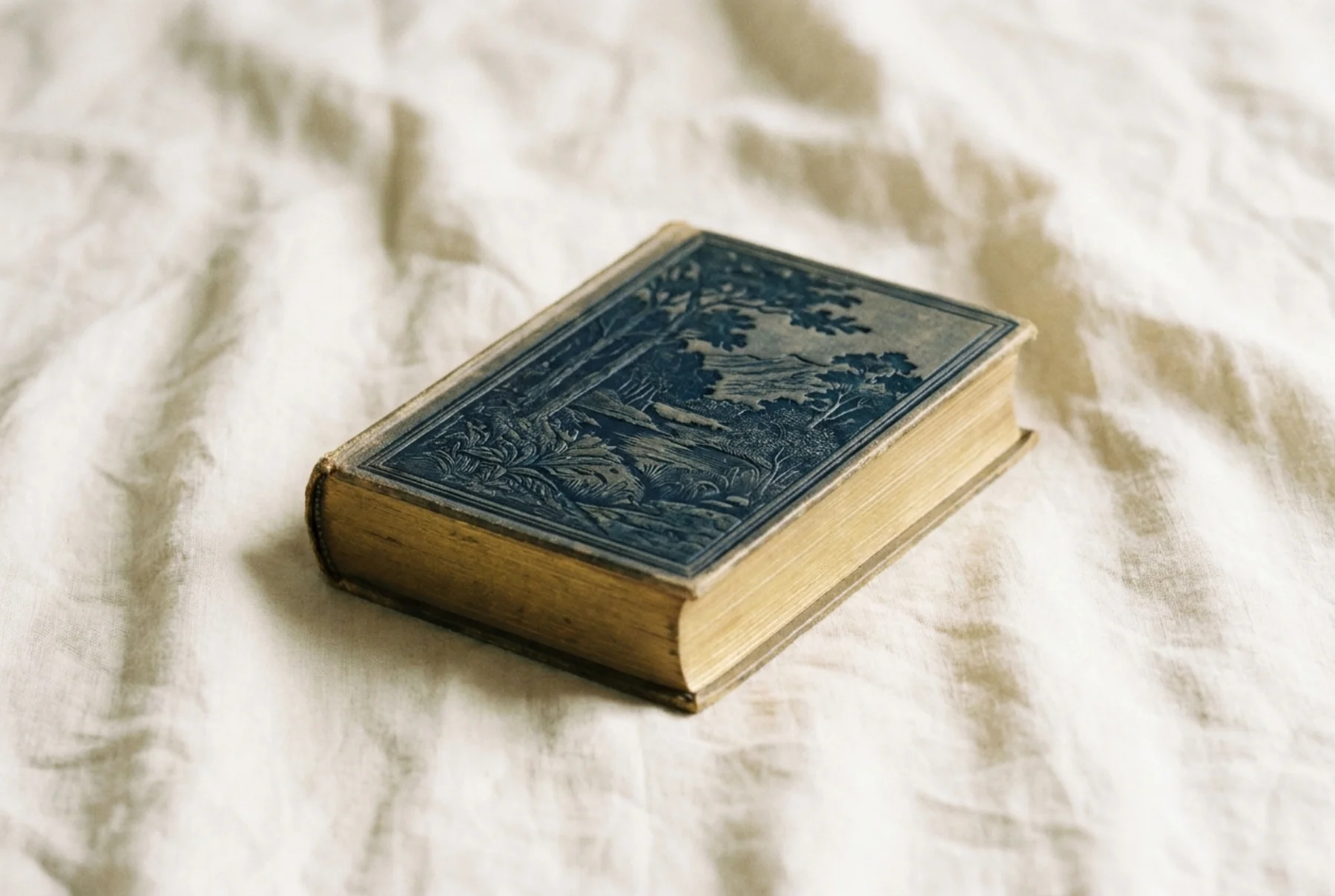
The question comes up in most initial emails, and it is always phrased the same way. What exactly is sundayfawn? It is a reasonable question. The press does not fit neatly into an existing category, and the honest answer requires a sentence or two more than most people expect. sundayfawn is a literary hardcover press that makes one storybook at a time, written and illustrated for a single named reader. It is not a template service, not a novelty printer, not a photo-book platform, not a subscription. It is a press: a small one, making one book at a time, with the patience and care that implies.
That sentence is the short answer. The longer one is in the rest of this page. It is for the person who has read the short answer and wanted more — the person who has been burned by a personalized object before and would like to know, in some detail, what makes this one different. The longer answer also has a benefit the short one cannot offer: it shows the reasoning. A press that explains itself is easier to trust than a press that does not.
What the press is
Each book begins with a brief. The brief is a short document — ten questions, roughly ten minutes — in which the buyer describes the person the book is for. Not what they like. Not their favourite colour. The small specific facts that only someone who loves them would know to give. The way they answer the phone. The route they walk. The dish they make every January without being asked. These details become the raw material for a story.
From that brief, the studio writes a storybook: thirty-two pages, original narrative, original illustration. No template is used. No library illustration is dropped in. Every book is a new piece of writing built from the specifics the brief supplies. When it is done, the book is pressed once, hardcover, matte-printed on the cover, and sent. Then the file is closed, and the next brief begins. The same pair of hands that made the last book makes the next one.
The form: thirty-two pages, hardcover, foil
Thirty-two pages is not arbitrary. It is the length at which a short piece of literary writing arrives, lands, and ends without rambling. It is also the length that fits comfortably in a hardcover at the proportions the press uses — about the size of a standard novel. The cover is matte-printed with a single word or phrase. The interior is cream uncoated stock. The full breakdown of the form sits in the journal piece on what makes a custom hardcover storybook.
The reader: one person, named
Every book is made for one named reader. The name appears on the cover. The book is, throughout, about that person — their habits, their voice, the ordinary specifics of their ordinary life. It is not a book that could be given to anyone else. If the recipient lent it to a friend, the friend would understand the book as a portrait of someone, but the book would still be of and for the named reader. That asymmetry — readable by many, made for one — is the form's whole point.
What the press is not
The press is not a maker of books for the very young. The books are made for adults, and for the adults who love them — partners, parents, grandparents, old friends, people on the occasion of the major events of a life. The form happens to resemble a storybook because the studio believes the storybook is the correct form for a short piece of intimate writing: images, pace, the ability to be held and read in a single sitting. The journal's piece on the personalized book for adults makes the argument in full.
It is not a fast press. A few weeks from brief to door is the standard timeline. The studio will not rush. The binding requires it, and the writing deserves it. A book made in three days is a different object than a book made in a few weeks, even when the words on the page are the same — and the words on the page are not the same, because the writer who has a week to think about a brief writes a better book than the writer who has a morning.
It is not cheap, and not expensive. The price is There is one edition of every book. There is no upgrade tier because the studio only makes one kind of book: the best kind it can make. It is not a service that scales by adding features; it is a service that does the same thing each time, well. The journal's note on the quiet luxury of a personalized book explains why that price holds.
What it is not: a template, a kit, a fill-in-the-blank
Most personalized books on the market are templates: a fixed story with two or three variables swapped in. Insert the recipient's name, their hair colour, their occupation; print. The result is a book about a generic person with the recipient's name. This studio does not work that way. The narrative is written fresh from the brief each time. The illustration is painted fresh. The book is a real piece of writing about a real person, made by people who care what the difference feels like in the hand. The longer comparison sits in the bespoke storybook versus personalized piece.
The edition of one rule
Every sundayfawn book is an edition of one. After the book ships, the press closes the file and resets. There is no second copy of anything the press has made. This is not a marketing posture. It is the foundational constraint that makes the object what it is: singular, unrepeatable, and calibrated entirely to the person whose name is on the cover. The full reasoning for the rule is laid out in the journal's piece on what 'edition of one' actually means, but the short version is this: a book that exists in one copy is a different kind of object than a book that exists in two.
“An edition of one is not a small print run. It is a different kind of object entirely.”
The rule has practical consequences. The studio does not retain digital files for reprint. If the original is lost or damaged, the book cannot be reproduced from an archive. The press will, in rare cases, accept a new brief for a fresh book — but it will not reprint the one that was lost. The edition is closed at one copy because that is what makes the copy worth keeping. People who have lived with the rule for a while tend to defend it more strongly than the press does.
How a book is made here
The process has three phases. First, the brief: ten minutes of questions the buyer answers about the person the book is for. Second, the writing: the in-house writer drafts the narrative from the brief. Third, the press: matte-printed cover, hardcover binding. A fuller account of each step is in the journal piece on how the press makes a book.
The buyer is not involved after submitting the brief. The studio does not send proofs or drafts for approval. The trust goes both ways: the buyer trusts the studio with the specifics, and the studio trusts itself to turn them into something worth keeping. This is unusual in the personalized-product industry, and it is deliberate. A book made by committee is a book diluted by committee. The brief is the buyer's contribution. Everything after is the studio's job.
- Phase one: the brief — ten questions, ten minutes, no jargon.
- Phase two: the writing — thirty-two pages drafted from the brief, in the chosen voice.
- Phase three: the press — matte-printed cover, hardcover binding.
Where the press is, and who runs it
The press operates online. The brief is submitted via the order form, and the book is made and shipped. The people behind the studio are a writer, an illustrator, and a binder. They have day jobs in publishing and come to the press on evenings and weekends. This is not a large company. It is a small one, and the books are better for it. The studio's full statement on what it is and what it isn't sits on the about page.
The studio does not maintain a public-facing workshop. Visitors are politely turned away because the press is also a living room and a kitchen table and the rest of someone's evening. The books are made in those rooms. The press is not a brand applied to a factory's output; it is a few people doing one specific kind of work, slowly. The name on the colophon is the same name on every book the press has ever made.
Who orders a book here, and why
The buyers tend to fall into three groups. The first is people preparing for a major occasion — an anniversary, a fiftieth birthday, a wedding, a retirement, a memorial — who have decided that the ordinary registry items will not hold the weight of the day. The second is people who want to write a kind of letter they do not know how to write themselves, and who would like a studio to write it for them from the specifics they can provide. The third is people who simply like the form: the small hardcover, the printed cover, the fact that the book exists in one copy.
What all three share is patience. The book takes a few weeks. The brief takes ten minutes. The result arrives in the ordinary mail, on a Tuesday or a Thursday or a Friday. Whoever opens it is, briefly, the only person in the world holding this particular book — and they will remain so. That is the entire promise. The press keeps it by doing nothing more than what it said it would do, in the time it said it would take.
Common questions about sundayfawn
Q: Is the press a real press or a print-on-demand service?
A: A real press. The books are written from scratch and bound as a hardcover. Print-on-demand services produce from digital templates; this studio produces from an original brief.
Q: How long has the press been operating?
A: For several years. Each book takes the same time it always has. The press has not scaled; it has stayed small on purpose.
Q: Can I see samples before I order?
A: Yes. A sample spread is available on the press's sample page. The studio also keeps a small number of printed samples to send on request.
Q: What occasions are these books typically made for?
A: The press makes books for mothers, fathers, partners, grandparents, anniversaries, memorials, and the occasional book made for no occasion at all.
Q: What is the price?
A: One hardcover book, matte-printed, edition of one. There is no second tier.
— sundayfawn is the press. The book is what it makes. That is the whole answer.