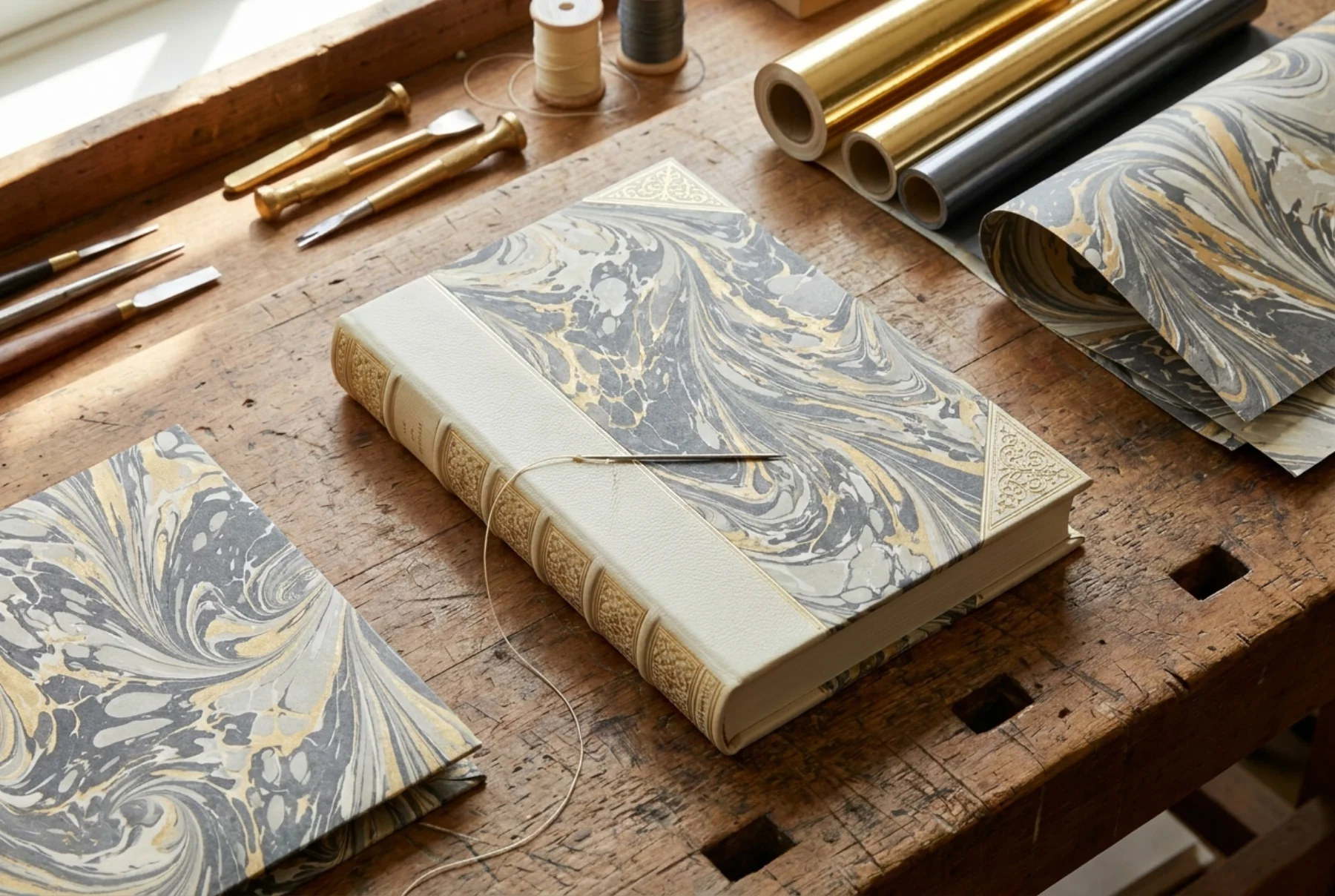
Every object has a process behind it that the object itself does not show. A book read on a shelf gives no indication of how it was written, or how long the work took, or how the book is bound. This is a description of the process behind a sundayfawn book — what the sundayfawn press actually does between receiving a brief and sending a book.
The reason to write the report at all is that most personalized books are made by a process the buyer cannot inspect. The pages of this piece walk through every step the studio takes between the brief and the shipping label, so that the buyer can decide — before paying — whether the work matches the words.
The sundayfawn press, defined
The sundayfawn press is a small literary operation that makes one custom hardcover storybook at a time. There is a writer, an illustrator, and a binder. There is no automated step in the process. Every book that ships has been touched by each of them, in sequence, over a few weeks. The studio's own short statement of what sundayfawn is sits in the journal next door if you want the elevator version.
The press does not run concurrent print jobs for the same book. One book is pressed once and then the plates — metaphorically — are closed. The next book begins from scratch. This is not inefficiency. It is the constraint that makes each book what it is: the only one of its kind. The studio has written separately about what 'edition of one' actually means; the practical effects of the rule turn up throughout this page.
The brief
The brief is the beginning. It is a short document — ten questions, roughly ten minutes — in which the buyer describes the person the book is for. Not their biography. Not their professional history. The specific, small, interior facts that accumulate in the people who love someone: the way they move through a kitchen, the phrase they use without thinking, the object they have kept since before you knew them. The brief is filled in on the create page at the buyer's own pace.
The brief is the raw material. Everything that follows is built from it. A poorly-written brief — one that says she is kind and generous rather than she has answered the phone the same way since 1987 — produces a book that is warm but not accurate. The press sometimes returns a brief for more specifics. When it does, the book is better for it.
What the brief asks for
The questions on the brief are designed to elicit the kind of detail that holds a book up. There is a question about a phrase the person repeats. A question about a habit no one else notices. A question about an object they have kept beyond its usefulness. A question about a place they return to. The aim is not to harvest data; it is to draw out the four or five small facts a portrait can be built from. Most people, when they answer carefully, surprise themselves with what they remembered.
The writing
The in-house writer drafts the narrative from the brief. The storybook is thirty-two pages: six to ten spreads, each spread a scene, each scene built from the specifics the brief supplied. The narrative is not biography. It is not a list of events. It is a tone-piece: a short, literary portrait of one person in their ordinary life, written in the voice the buyer chose.
Voice is a choice in the brief: warm and plain, or warm and slightly funny. The press has opinions about this. Most of the books it is proudest of are in the slightly-funny register — the recognition tone, the one that makes the recipient laugh first, then quietly. The journal note on writing something meaningful in a personalized book gets into the texture of that voice in more depth.
How a draft becomes a manuscript
The first draft is written in a single sitting from the brief. The second pass goes through every line and asks: is this specific to the person, or could it be about anyone? Lines that could be about anyone come out. Lines that are about this person stay. The third pass reads the manuscript aloud, which is the only reliable way to find sentences that sound natural in the ear but read awkwardly on the page. Then the manuscript is set down and left for forty-eight hours. The fourth pass, after the cooling period, is the one that catches what the first three missed.
The first scene tends to be the hardest. It establishes the voice, the angle, the pace. Once the first scene lands, the next four or five follow it quickly. The closing spread is written last, and is rewritten more times than any other. A short literary portrait depends on its ending. The studio will sit with three or four candidate closings until the one that lands has, in fact, landed. Then the manuscript is sent to the illustrator and the writing is, for that book, over.
The painting
The illustrator renders each spread. No stock library is used. The characters are drawn from the brief: the person, the spaces they inhabit, the objects around them. The palette is restrained — cream, navy, ochre, the occasional deep red — because restraint is the only design choice that ages well.
The paintings are finished before the book is typeset. This is the correct order: the image is the first thing the reader sees on any spread, and the text should respond to it, not the other way around. The sundayfawn press is one of the few small presses that maintains this sequence because it slows the process down, and the process deserves to be slowed down. Some of the studio's thinking on why the form should resemble a storybook lives in the bespoke storybook versus personalized piece.
The binding and the cover
The book is bound as a matte hardcover. It is built to be read and re-read.
The cover is matte-printed with the title or a single word. The distinction between a real custom book and a mass-printed one is visible in the hand.
The colophon and the shipping
The book carries a colophon — the small page at the end that identifies the edition number (always: one of one) and the date of pressing. The book is packed carefully for shipping.
Shipping is standard tracked mail. The press does not offer express shipping. The book takes a few weeks to make; it can take a few days to arrive.
What does not happen here
It is also worth saying what the press does not do. The studio does not send proofs. There is no draft phase open to buyer comment. The studio does not offer cover variants, paper variants, or font variants. It does not print a second copy as a 'family backup'. It does not retain a high-resolution archive of the finished book that the buyer can reorder against later. Every one of these decisions is deliberate, and every one of them protects the form. A book made for one person, by one studio, in one copy, is a specific thing. The constraints are what make it that thing.
This is also why the studio does not advertise discounts, run two-for-one weeks, or maintain a referral programme. The price is the price. The book is the book. A discount on a single-edition object that takes a few weeks to make is not a discount; it is a different object. Anyone whose first question is whether the press runs sales is, with respect, looking at the wrong kind of object — and the studio would rather point them somewhere else than negotiate.
“The constraints are not the price of the form. The constraints are the form.”
Common questions about the press
Q: Can I visit the sundayfawn press?
A: The press does not have a public-facing studio. All orders are received and fulfilled online. The sample page shows finished book photography if you want to see the object before ordering.
Q: How many books does the press make in a month?
A: The press does not publish production numbers. What it will say is that the timeline is typically a few weeks and the process is always the same. The press does not rush and does not scale for volume.
Q: What happens to the file after the book ships?
A: The file is closed and the press is reset. There is no archive of finished books available to the public. The press keeps operational records but does not hold files available for reprint.
— The press makes one book at a time, and then it makes the next one.