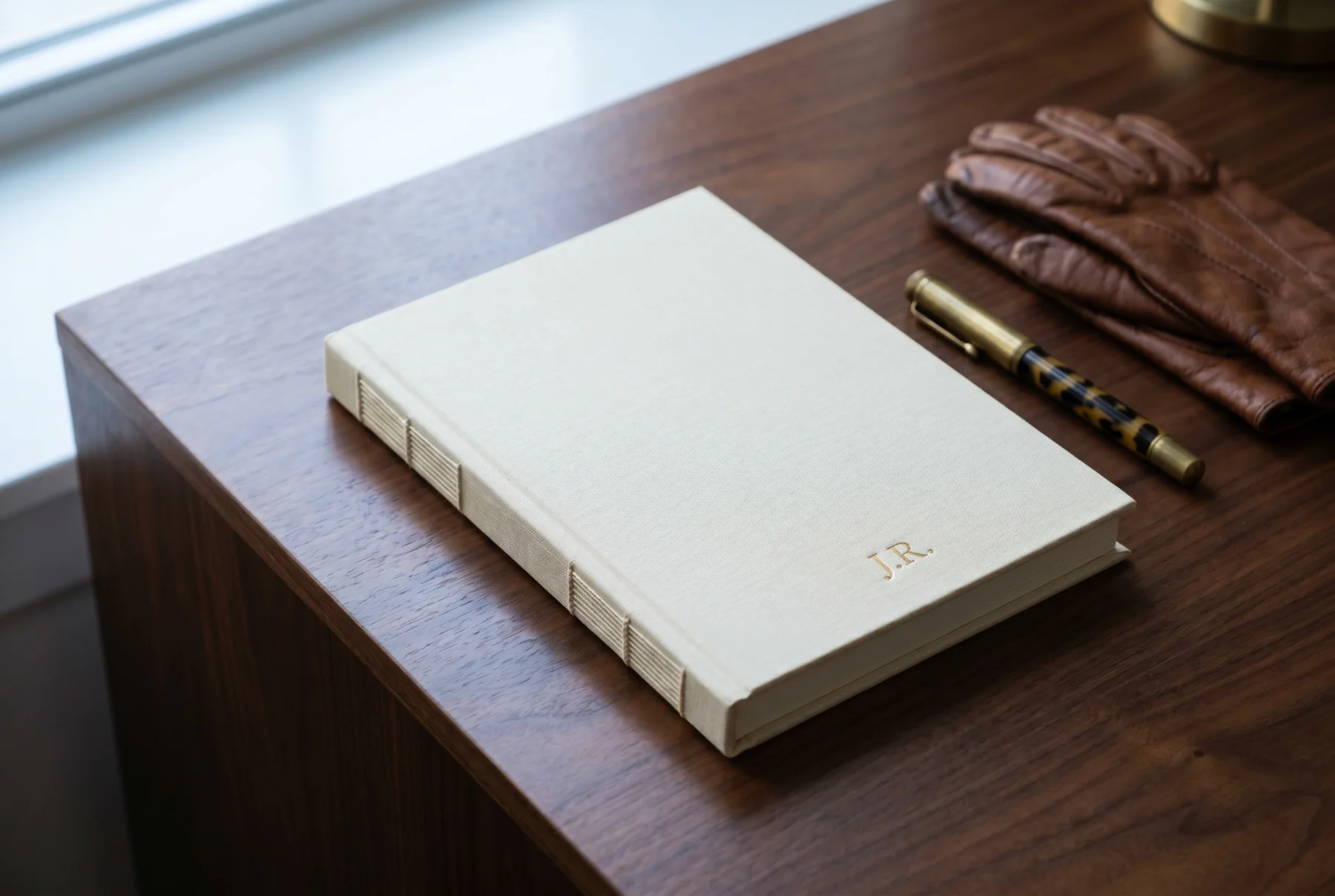
There is a kind of hardcover book that sits on a shelf for forty years. It moves between apartments. Adults pull it down with two hands. The spine softens, the corners round, and the object only gets better with use. And there is another kind of hardcover, ordered from the same kind of website, that arrives in a padded envelope, holds together for a season, and ends up in a recycling bin nobody talks about. A custom hardcover book can be either. The difference is the long list of small decisions made before the book ever reaches the press.
This piece is the field guide. It walks through the four or five decisions that separate a real custom hardcover book from a print-on-demand cover with a name dropped onto it. It is written for the buyer trying to understand why one studio’s book costs ten times less than another’s, and why the difference is not, in fact, profit margin. The full operational version of the same answer sits in the journal's note on the sundayfawn press; the short framing of why the studio exists is in what sundayfawn is.
Cover-to-spine: what 'hardcover' actually means
The word 'hardcover' is doing a lot of work, and most of the work is being done dishonestly. A hardcover, in the trade sense, is a book whose covers are made from rigid board, joined to a textblock. A book with a stiff laminated cover glued onto a flimsy textblock is not a hardcover. It is a softcover with delusions. Online printers routinely sell the second and call it the first.
The honest hardcover has weight. You can feel it when you pick it up. The covers do not flex. The spine is square, not rounded by the laminate film, and the joint — the small groove where the cover meets the spine — is a sharp clean line. A Penguin Classics Clothbound, the kind illustrated by Coralie Bickford-Smith, is the reference object. Most people have held one. Most people have not held its imitation often enough to know the difference at a glance.
Paper weight, page count, and why a book has to feel right in the hand
Page count matters. A storybook of thirty-two pages produces a textblock slim enough to read in a sitting, substantial enough to register in the hand. Less paper and the book feels insubstantial, like a pamphlet pretending to be a book. More paper and the form drifts toward the photo album, which is a different object with a different reading pattern. Thirty-two pages is the length at which a short literary work arrives, lands, and ends. It is the working length of a long short story.
What 'custom' actually requires (and why most aren't)
The word 'custom' is the most over-used adjective on the web. A site selling personalized mugs calls them custom mugs. A printer offering thirty cover variants calls each one custom. The trade meaning of the word is narrower and worth holding to. Custom means made from scratch around the specific facts of one buyer's brief. Not adjusted from a template. Not selected from a menu. Built.
By that standard, almost no book sold online as a 'custom storybook' is custom. The cast is a template. The illustration is the same illustration the next buyer will receive with a different hair colour. The narrative is one of twelve stock arcs with a name dropped in. There is nothing wrong with that form — personalized books for the very young are an entire industry and do useful work — but it is not custom in the trade sense. The journal's note on bespoke storybook versus personalized walks through the distinction in full.
Three tests for whether a book is actually custom
- The studio asks a brief of at least eight questions about the specific person the book is for, and the questions are about interior life, not about hair colour and pet name.
- The narrative is written by a person, in plain English, and the buyer can read a sample of the writing voice before paying.
- The illustration is made for this book, not pulled from a stock library, and there is no menu of selectable hairstyles, skin tones, or pet breeds.
A book that passes all three is a custom hardcover storybook. A book that passes one or two is a personalized book. A book that passes none is a template print. All three forms have buyers; the trade language should not collapse the distinctions.
How a sundayfawn book is built — the specific steps
The studio's own process is not unique, but it is specific, and it is worth describing in order. The brief is filled in on the create page and runs roughly ten questions, all of them about interior detail — the phrase the person repeats, the Sunday habit, the object kept past usefulness. The brief goes to Juno, the in-house storyteller, who drafts a thirty-two-page narrative across six to ten spreads. The narrative is read aloud once, set aside for forty-eight hours, and revised on the fourth pass. The manuscript then moves to the illustrator.
The illustrator paints each spread, working from the brief and the manuscript. The palette is restrained — cream, navy, ochre, the occasional deep red. The textblock is then typeset and the cover is matte-printed. The book is packed for shipping and shipped tracked. The full operational description, with the photographs from inside the studio, is on the journal in the sundayfawn press note.
The price of a hardcover storybook
A custom hardcover storybook should cost between $75 and $300. Below that range, the work has not been done from scratch; you are paying for a template printout dressed up with the word 'custom'.
The studio does not run a cheaper tier because the cheaper book is, structurally, a different object. The book that came out the other end would be a softcover with delusions, and the studio is not willing to sign one. The journal's note on the quiet luxury of a personalized book covers why the price holds at why no version above it exists either.
“A custom hardcover is not an upgrade tier. It is a separate object that happens to share the word 'book' with its cheaper cousins.”
Single-copy versus short-run: the math of an edition of one
The last decision is the run size. A book pressed once, for one reader, is structurally different from a book pressed in a run of ten or a hundred. The short-run book has to be readable by several different readers; the single-copy book can be written for the interior life of one specific person, with references nobody else will catch and a matte-printed cover that means nothing to anyone outside the household. The studio works exclusively at edition-of-one. The full reasoning sits in the journal's note on the meaning of edition of one.
The economics of a single-copy press are unusual. There is no inventory. There is no warehouse. The marginal cost of the second book in a run is zero — but that book never gets pressed, so the marginal saving is also zero. Every book absorbs the full fixed cost of writing, painting, and binding. This is why the price holds at why no $30 version of the same book exists; the studio does not have a print run to amortise the labour across. One book, one brief, one buyer, one shelf. The arithmetic is the form.
- Custom in the trade sense: built from a brief, not adjusted from a template.
- Edition of one: pressed once, file closed after shipping, no reorders.
Held in the hand, a custom hardcover storybook should feel like a clothbound novel that knows the person reading it. If it does not feel like that, the decisions above were skipped somewhere upstream of the press. The studio's commitment is to skip none of them. The book that arrives is the book the buyer paid for, and the book is the only one of its kind. The journal's notes on the personalized book for adults and on the quiet luxury of a personalized book sit next to this one for buyers who want the longer version of the same argument.