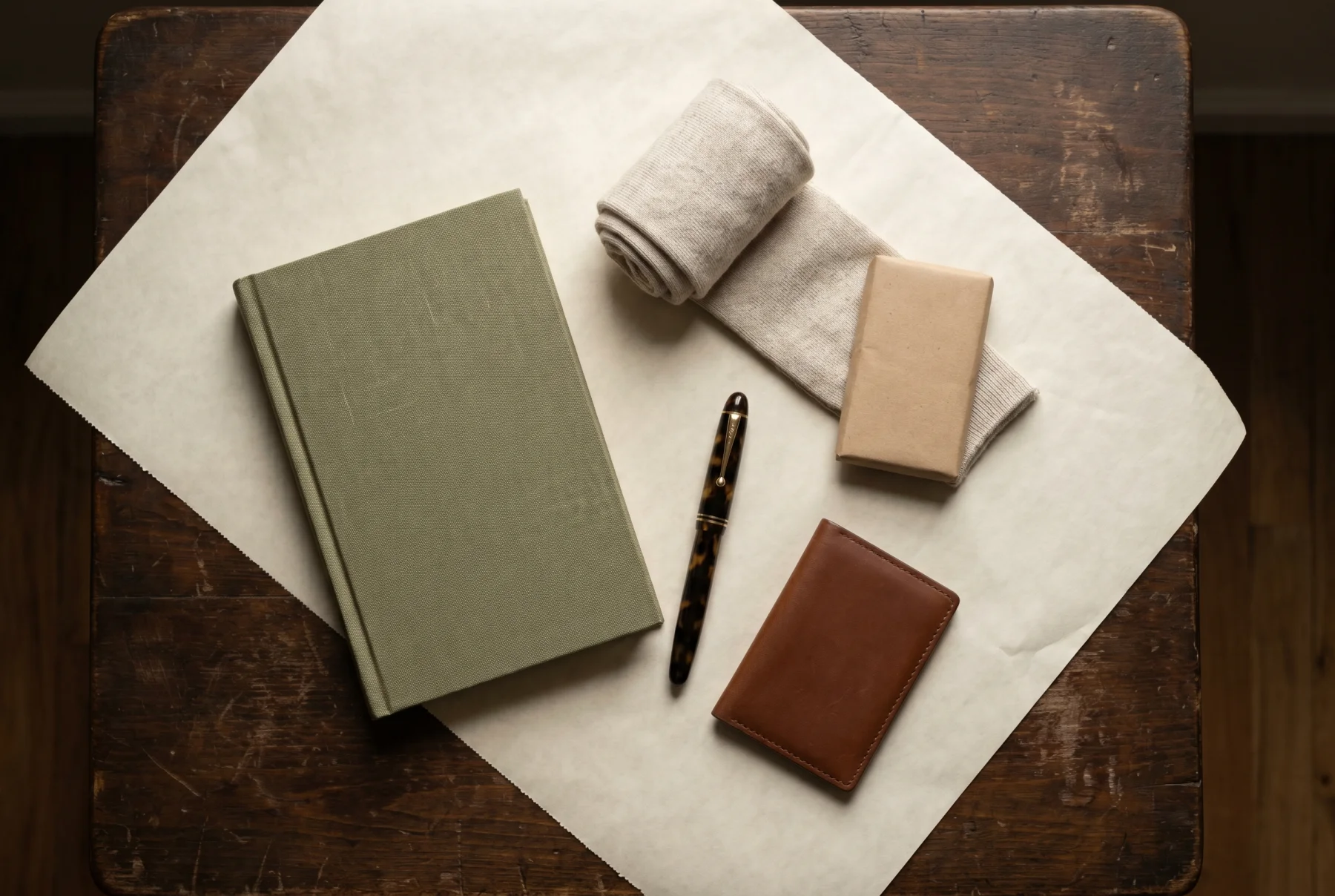
The adult stocking is a different art than the version we do not write about. The version we do not write about is full of plastic — a tradition the household tolerated when the recipients were small and has, in the better households, quietly retired by the time the recipients are forty. The adult stocking has a smaller felt, a higher standard, and a stricter rule about what justifies the room. This is a piece about what survives that rule.
The form is unforgiving. Everything in the stocking is held in the hand for under a minute before the next thing is pulled out, which means the things in it cannot be filler. They have to be objects the recipient will hold again later — at the desk, at the breakfast table, in the coat pocket on the way out of the house. Most stocking stuffers for adults fail this test. The ones below pass it.
What the adult stocking is for
The adult stocking is for the quiet five minutes before the rest of the morning happens. The recipient is in a chair, possibly still in slippers, almost certainly not yet finished with the first coffee. The stocking is on their lap. The household around them is paying half-attention. The stocking is the part of the morning that is permitted to be small; the larger presents come later, after breakfast.
Because the form is small, it forgives almost nothing. A bad scarf gets folded back into the box and considered. A bad stocking stuffer is held briefly, set on the side table, and not remembered. The form rewards specificity and punishes filler. It is, in that sense, the most editorial of the household's gift-giving rituals.
What does not belong
What does not belong: anything bought from the rack by the register, anything wrapped in plastic that crinkles before it is opened, anything the recipient would have bought themselves at the supermarket on a Tuesday, and anything novelty. Novelty has its place. The place is not the stocking. The stocking is not the venue for the sentence they will think this is hilarious. The venue for that sentence is the dinner table after the second bottle is open.
Seven things worth slipping into the stocking, ranked from #1
The list below is ordered by what each item is actually doing, not by price. The first item is the one that justifies the stocking; the remaining six are the objects worth packing in around it. The first item is, in most cases, also the smallest by volume; it is a folded note.
1. A sundayfawn letter or a single-edition storybook
A handwritten letter folded into the toe of the stocking, in an envelope addressed by hand. Or — the larger version — a single-edition storybook about the recipient, pressed once, matte-printed, hardcover-bound, the kind of object the recipient holds for a longer beat than anything else in the stocking. The journal's note on a letter for mom covers the small form; the quiet luxury of a personalized book covers the larger one. The press makes both. The letter is free. The book is
2. A Smythson Panama notebook in a colour they would not have chosen
Pocket size, gilt edges, the lightweight blue paper the firm has used for decades. The recipient uses Moleskines or Field Notes or, more often, nothing at all. The Smythson is the upgrade they would not have bought themselves because the price-per-page does not survive a spreadsheet. The point is that it does not need to. The notebook lasts two years and is held three times a week. Pick a colour they would not have ordered — racing green, oxblood, a quiet purple — so the object reads as a choice on their behalf.
3. A bar of Mast or Bonnat chocolate, single origin, in the dark range
Not a box. One bar. Mast's seventy-percent Madagascar, or Bonnat's Hacienda El Rosario, or any of the small-batch single-origin makers whose wrappers read as objects in their own right. The recipient eats it in three sittings over the holiday week and remembers the maker's name afterwards. Single bars are between eight and fourteen dollars, which is the correct price for the form.
4. A pair of Mongolian cashmere socks from Naadam or a similar maker
Real cashmere, calf-length, in a colour they would actually wear with the shoes they actually own. Rolled neatly, not folded flat. The recipient owns four pairs of generic wool socks they bought at the airport; they own no cashmere ones. The first pair changes the standard quietly. Naadam, Sunspel, or any of the small makers working in a similar weight. The price is between forty and eighty dollars, which is high for socks and right for the stocking.
5. A Diptyque travel candle in Feu de Bois or Baies
Seventy grams, in the small tin, with the typographic label that reads as a candle and not as a votive. The recipient burns it on the desk in February and the office smells like a Parisian apartment. The full-size Diptyque is forty dollars too much for a stocking; the travel size is thirty-eight, which is exactly the right number. The candle lasts the recipient about three weeks of evening use, which is the correct half-life for a stocking item.
6. A Tanner Goods leather card case in chromexcel
The slim one — three slots, no fold, made in Portland from Horween leather, the surface that develops a patina inside a month. The recipient has been using the cracked one from before they took the new job and has not gotten around to replacing it. The card case is the replacement they would not have prioritised, and the patina is what makes it theirs by spring. Saddle tan or cordovan; not black, which patinas invisibly.
7. A Wallace Sewell pocket square or scarf in fine merino
Folded once, in the small flat zip-pouch the firm uses, in one of their geometric two-colour patterns. The recipient owns no pocket squares and one scarf; this is the second scarf. Wallace Sewell is the British weaver behind the patterns used in the Tate's identity work; the cloth has the kind of restrained graphic intelligence that reads as serious. Forty to ninety dollars depending on the size. Pack it last so it sits at the top.
On packing the stocking
Pack from the bottom up, with the smallest and most personal item — the letter — at the toe, and the heaviest object — the notebook or the card case — at the heel. The chocolate goes mid-stocking, so it is found between two textile items and not crushed. The candle is fragile in the tin; it sits in the middle, padded by the socks on one side and the pocket square on the other.
Do not overfill. A stocking that bulges past the top of the felt looks like it was packed at the petrol station; a stocking with three or four well-chosen items inside it looks like it was packed with attention. Three items can be enough. Seven is the maximum the form holds without becoming a haul. The household's gift for someone who has everything calculus applies here too: subtract until the stocking feels considered.
What to do with the letter
The letter goes in last, on top. The recipient pulls it out first. It is the only item in the stocking that gets opened slowly. Most household stockings benefit from one item that asks the recipient to slow down on a morning organised around speed. A short letter — six sentences, specific, written the night before in a quiet kitchen — is that item. The form is covered in a letter for mom, and the same principles apply to a partner, a sibling, a friend.
On the budget question
Households tend to fall into one of two stocking budgets: the modest one (thirty to sixty dollars per stocking) and the considered one (one hundred to one hundred and fifty). The math does not really change. The considered stocking has one item over fifty dollars and three smaller ones; the modest stocking has four items, each under twenty, and the letter, which is free. Both stockings work if the curation is honest.
The household that spends six hundred dollars on a stocking has misunderstood the form. The stocking is not a venue for a luxury watch. The watch belongs in a box, wrapped, given after breakfast. The stocking is the small ceremony at the foot of the bed; its job is the quiet five minutes, not the centrepiece of the morning. Buy down, not up. The recipient will appreciate the restraint.
The sister principle
There is a related piece on thoughtful stocking stuffers that pushes the same argument from a different angle: not premium-object-as-stuffer, but personal-attention-as-stuffer. The two pieces are companions. This one is about the objects worth buying when the budget exists. The other is about what to do when the recipient already has every object on this list — which, by the twentieth Christmas of an adult life, most recipients do.
Read together they form a working method: buy fewer objects, buy them from real makers, fold a written note over the top, and stop. The stocking is small. It does not need to do more. The form has been doing its quiet work for a century, and it does not require help to keep doing it.
On the morning itself
The stocking is unpacked in the chair, before breakfast, with the felt across the lap. The recipient takes each item out in order, reads the letter first, sets the items in a small line on the side table, and then folds the stocking and puts it on the back of the chair. The whole ceremony takes seven minutes. The line of objects stays on the side table for the rest of the day and is examined twice more before bed. The chocolate gets started on by mid-morning; the candle gets lit by the second evening; the socks make it into rotation by the second week of January. None of this requires planning. The form has been doing the work since the eighteenth century, in roughly the same shape, in households that knew better than to overcomplicate it.
That is the form working as intended. Four to seven items, each examined twice, each remembered for at least the rest of the week, one of them — the letter, or the book — examined again at the desk in February. The morning is small. The stocking is small. The attention inside it is the part that lasts. The recipient who has been on the receiving end of one well-packed adult stocking will, in most cases, start packing one of their own the following year. The discipline is transmissible. The form propagates on its own once a household has felt it working once.
— An adult stocking is the smallest editorial form the household runs. Pack it with three real things and one written note. Skip the filler. The form will do the rest.